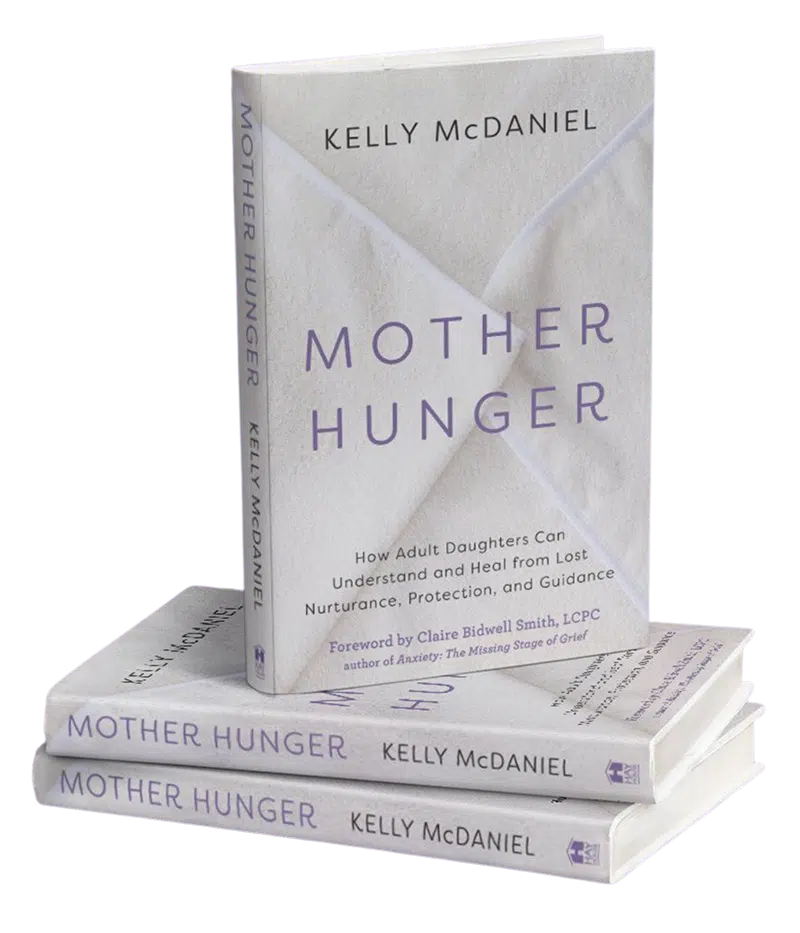
I do not remember how I came upon Mother Hunger by Kelly McDaniel, but I remember, even years later, the impact it had on me. I am an avid reader of self-help and psychology. I am always collecting knowledge to better understand my inner world. Sometimes we come across words that name an experience we have been carrying deep within us. We can feel empowered when we finally have language for what we didn’t know how to describe. Mother Hunger is one of those terms for me.
What the book explores — What is Mother Hunger
Mother hunger is a deep wound that results from the absence of three primary maternal needs: nurturance, protection, and guidance. Mother hunger begins for us as infants, so we don’t yet have the language for what we are experiencing, but our bodies remember. Kelly describes this wound as an “invisible burden.” I know exactly what this feeling is. I didn’t always have a name for it, but I remember feeling it from my earliest memories. The invisible fog of mother hunger that surrounded me was always present.
Kelly meets the reader with grace while she explores the deep and profound wound of mother hunger. Kelly explains how mother hunger can be linked to addiction, complicated relationships with food, unhealthy relationship patterns, and more. I was grateful to see that adoption is explored because, in my opinion, it’s the most primal and insidious mother wound of all.
Kelly reveals how being a “good baby” is not quite as good as society makes it seem. I always heard what a “good baby” I was. When I was younger, I was proud of being so good that I didn’t cause any problems, you know, having needs. Now I cringe when I reflect on all the times my parents voiced what a “good baby” I was. Being adopted as an infant was very layered for me. I believed that my ability to be good was my way of being kept by my parents. Of every choice I made, I always had this fear running in the background of making a mistake and being unchosen and thrown out into oblivion.
I felt validated over and over again with each chapter that I read. A dark, lonely piece of me came back to life a little each time I read Kelly’s validating descriptions. I also love that Kelly references many other authors to illuminate her points further. I am the person who often looks up the other authors and books mentioned.
Mother Hunger’s deeper wound
As if experiencing mother hunger wasn’t enough on its own, Kelly goes on to explore “third-degree mother hunger”. “Third-degree mother hunger” is a more extreme form that Kelly calls “maternal cruelty”. If you were scared of your mother, you may have experienced this more extreme mother wound.
At first, I wasn’t sure I would get much out of the chapter on cruel mothers, but I ended up feeling even more validated. My inner struggles were mirrored back to me as Kelly describes all the issues and patterns that adult women may have difficulty with. I share many physical, emotional, mental, and medical symptoms and issues that Kelly mentions for women with the added layer of “cruel and frightening” mothers.
I don’t check all the boxes per se, of “third-degree mother hunger”, but I check most of the symptoms of it. Interesting, isn’t it? My mother was not verbally abusive at all; rather, she was emotionally neglectful and distant, critical, and lacked warmth. I knew my mother loved me, but I also believed her love was conditional. I remember being scared all the time that I would do something wrong, that my mother’s mood would shift. Ultimately, I was scared of being abandoned again.
I do believe my being adopted set me up to exacerbate my mental & emotional issues that would indeed come from my adoptive mother. I would be intrigued to explore the adoption side of things more in-depth.
Kelly McDaniel poured herself into this book, and I’m thankful that I came across it. The material is rich with exploration of a daughter’s most important relationship at the beginning of her life, the one with her mother. Our mothers are supposed to teach us how to securely attach, and if certain elements were missing, this may hinder us for the rest of our lives.
It is said that the relationship we have with ourselves sets the tone for all the other relationships we have. It is our mothers who first model this relationship to us. Either our relationship to ourselves is strengthened, or it’s distorted. This is why absent, abusive, and toxic relationship dynamics could feel like home for us.
Deeper into my personal Reflection
Tears ran down my face as I read the pages of this book for the first time. There is finally a name for my deepest pain that is always running in the undercurrent of my life. Every choice that I have made has been shaped by this mother hunger wound. I felt validated, and I felt —not crazy— thinking about how everything always seemed so much harder for me than other people.
I remember in Kindergarten, wondering why my coloring page didn’t look as good as the girl’s sitting next to me. I put so much effort into my page, and hers seemed so effortless.
In college, I chose my major because it was easy, not because I was actually talented and passionate about it. I was scared I wasn’t smart enough to graduate. Yes, my mother knew why I chose my major; she’s the one who encouraged me to choose the easy one. Being encouraged this way was a theme, and it led me to feel as if I’m too much & not enough at the same time. This too much & not enough paradox would follow me throughout my life and only settle down after years of therapy. To this day, I’m not entirely sure what she was actually afraid of, and why she didn’t ask me what I was interested in studying. She taught me how to make choices based on fear, not joy or possibility.
She did not put me down verbally, but she didn’t allow me to be myself either. I don’t think she had any idea of what was happening in my inner world and how scared I was, because I never told anyone. My parents were very surface-level people. They had deep emotions, of course, but did not or could not articulate or express their emotions. I grew up scared of my big emotions and spent my days shoving them down rather than expressing them. Even joy, because big emotions, positive or negative, came with a sense of unease.
I see how mother hunger flowed through all the women in my family, going back generations. My maternal grandmother adopted me, and she is who I feel was my mother. My birth mother, her sister, and I were essentially raised by the same mother, even though we all received different versions of the same woman. I grew up with a lot of secrets about how I actually fit into this family. To this day, all three of us daughters are estranged from each other. Mother hunger separates us from ourselves, and sometimes mother hunger makes our wounds too great to allow for reconciliation.
Who is this book for & how can it help?
Mother Hunger is for any woman who has experienced or even wonders if they experienced a significant lack of nurturing, protection, and/or guidance from her mother or mother figure. Ask yourself, did your mother feel available to you, physically, mentally, & emotionally? Did your mother model healthy attachments? Was your mother able to regulate her emotions? Stay consistent while feeling the range of her emotions, or did her moods or emotions bring a sense of unease? Did your mother help you navigate the world without trying to control you? Depending on your answers to these questions, mother hunger may bring much-needed support to you. This is a great book to ask a loved one or partner to read as well, to better understand how your worldview has been shaped.
Reading Mother Hunger may help you:
- Identify if you experienced mother hunger—a deep, ongoing wound that is rarely talked about in depth
- Feel a sense that you aren’t alone
- Begin to learn a new language of what has been happening in your inner world
- Bring long-buried issues and hidden patterns into the light to begin healing
- Illuminate the generational pattern of mother hunger throughout the lineage
- Foster self-compassion and compassion for all the mothers in the family line
- Give yourself permission to seek the support that you didn’t have as a child
I would even if a small part of you is curious about what mother hunger is about, read the book. If the words mother hunger draw you in, there is a reason for that. Mothers come in many forms: biological, adoptive, caregivers, and mother figures. Just because you believe you had a healthy childhood, doesn’t mean you did not experience mother hunger. The mother hunger wound is a spectrum, and no matter how big or small the wound is, it matters, and it is longing to be witnessed.
For supportive partners & loved ones.
This is also a great book to ask a loved one or partner to read to better understand how your worldview has been shaped. We are all just doing the best we can with the understanding that we currently have. When those close to us have a little more tangible understanding of our inner world, it also invites them to go deeper into their inner worlds. Though sometimes it scares them.
You had an insightful breakthrough…now what?
Books are fabulous at giving us an ah-ha moment, a breakthrough, an insight. Books are not great at helping us put the breakthrough into action and thus change our lives. Reading words that name some of our deepest pain is beautifully moving and deeply needed. Since mother hunger runs so deep throughout our lives, it takes more than reading a book to evoke lasting change. The trauma that we have experienced was because we were left in isolation through our pain. To heal, we must seek support. The kind of support that we need is unique to the individual and where they are on their journey.
Maybe you’re already seeing a therapist. Maybe you never pursued therapy even after contemplating it many times. Maybe you’ve thought about attending a workshop or conference in the mental health realm, but you talked yourself out of it. Maybe you tried therapy once, but it didn’t work the way you wanted. I invite you to assess your true wants and needs for support. Doing the work involves more than acquiring knowledge. Knowledge is indeed powerful and necessary to understand, but the knowledge itself is often not enough to embody lasting change. Practical, actionable steps and support are needed to heal such deep wounds that have covered every aspect of your life in an invisible fog of pain and confusion.
Support Beyond the Book
Kelly’s website is as beautiful as it is resourceful. I love that. The resources she provides to go further and gain additional support are significant. As a former therapist and a client of therapy, I love seeing all the options available. There are resources linked for daughters and tools linked for professionals. There is also a directory of clinicians who have trained with Kelly to better understand the complexities of mother hunger.
For women needing extra support healing from “third-degree mother hunger” that Kelly brings to light in her book, Kelly recommends looking for clinicians who have one or more of the following certifications: Somatic training, EMDR, Family Constellation, & IFS (Internal Family Systems). I have personally utilized EMDR, IFS, & somatic modalities in my healing journey, and each has provided a different kind of support, and all have been tremendously helpful for me during my healing journey.
Last thoughts
Whether you know your relationship to your mother was difficult, non-existent, or if you wonder if there could be a hidden mother wound lurking in the shadows, Mother Hunger may be just the book that gives you the answers & support you’ve been longing for.
10/10 Recommend Mother Hunger! For those of us with this deep mother wound, the pages of this book touch dark places within us and illuminate them. The undercurrent of longing for biological, psychological, & emotional needs that were never truly met by the mothers and maternal figures in our lives leaves wounds that don’t have words. Kelly McDaniels’s Mother Hunger gives language to our deepest wounds, and thus empowers us to turn toward our pain, because we finally have a name for it.
10/10 Recommend Mother Hunger! For those of us with this deep mother wound, the pages of this book touch dark places within us and illuminate them. The undercurrent of longing for biological, psychological, & emotional needs that were never truly met by the mothers and maternal figures in our lives leaves wounds that don’t have words. Kelly McDaniels’s Mother Hunger gives language to our deepest wounds, and thus empowers us to turn toward our pain, because we finally have a name for it.
Copyright Kelly McDaniel, Mother Hunger® and kellymcdanieltherapy.com, All rights reserved.


Very interesting and well written. I’ll look forward to receiving your next one.❤️U